Drriti
0% Product Designer
Drriti Portfolio Hero Artwork
About 2026 Open to product design roles Selected work ↓ Contact ↓

Drriti Product Designer

Curiosity first. Then form, colour, rhythm and detail, until an idea becomes something you can feel.

I believe design can turn curiosity into experiences that people feel, understand, and remember.

Download resume

Capabilities & tools

Design
services

01 / Service

Product Design

End-to-end product work: research, flows, interfaces and prototypes, from the first question to developer handoff.
  • UX research
  • User flows
  • Wireframes
  • UI systems
  • Prototypes

02 / Service

Visual Identity

Branding systems built with clarity, restraint and emotional intent.

  • Logo
  • Colour & type
  • Brand guidelines

03 / Service

Editorial & Graphic Design

Print and digital layouts that communicate quietly yet effectively: books, covers, posters and collateral, built on a clear grid and prepared for press.

  • Layouts
  • Typography
  • Book covers
  • Posters
  • Social graphics
  • Print-ready files

04 / Tools

Tools I work in

Now, the work.

Selected work Resume

Bhartiya Khel Sutra

Role
UI/UX designer
Client
Khol Khel Pvt. Ltd.
Duration
8 weeks
Tools
Figma, Illustrator
Status
Launching soon

Case study · Client project

Bhartiya
Khel Sutra

Play traditions of India. A digital archive of 75+ traditional games, designed as a place you walk through, not a list you search.

The clickable prototype, a 40-second walkthrough.

01 — The challenge

From archive
to playground

Khol Khel had documented games from across India: rules, lineages, regional variants. Some entries are two lines, others carry centuries of evidence. A list or a product grid would flatten all of it.
  • Uneven density. Two-line rules next to pages of history.
  • Lost place. Games belong to courtyards, lanes and fields. A list erases that.
  • Two audiences. Browsers want to stumble on things. Teachers and parents want to search.
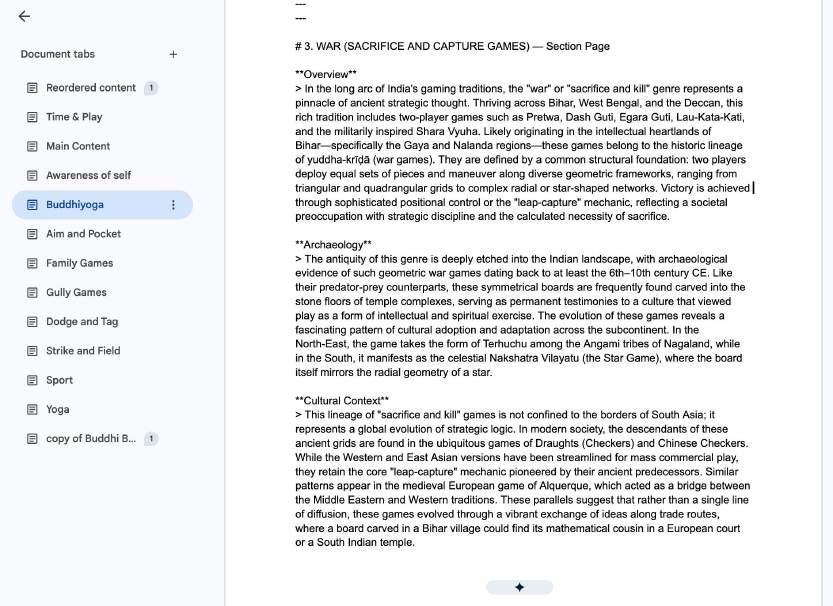
Research document
The client's written research for one game section: overview, archaeology and cultural context
Where it started: written research for every game, section by section.

02 — Structure

Nine places
for every game

I turned a research spreadsheet into a taxonomy. Each game gets two coordinates: an intellectual genre and a physical place. The place becomes the navigation.
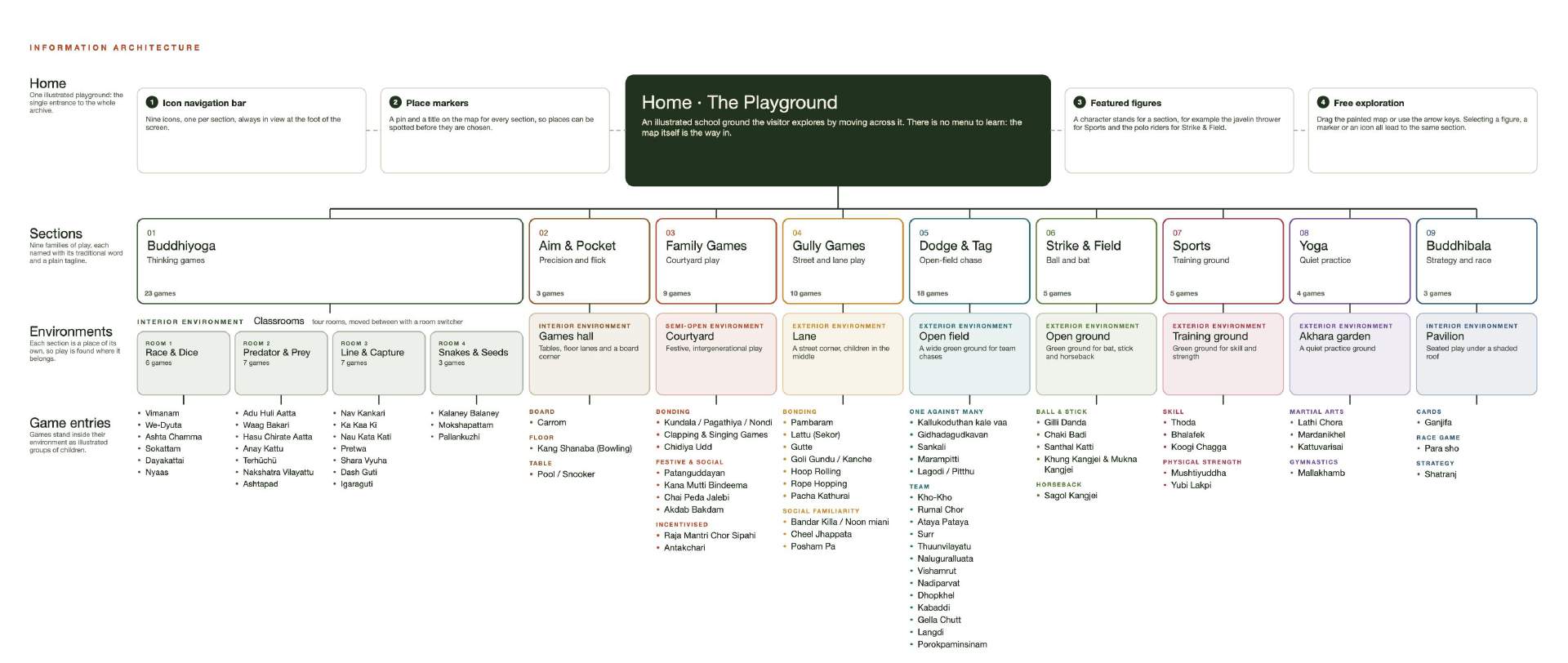
Information architecture: home, sections, environments and game entries
Information architecture: home → sections → environments → game entries.

03 — Interaction

Wander,
or search

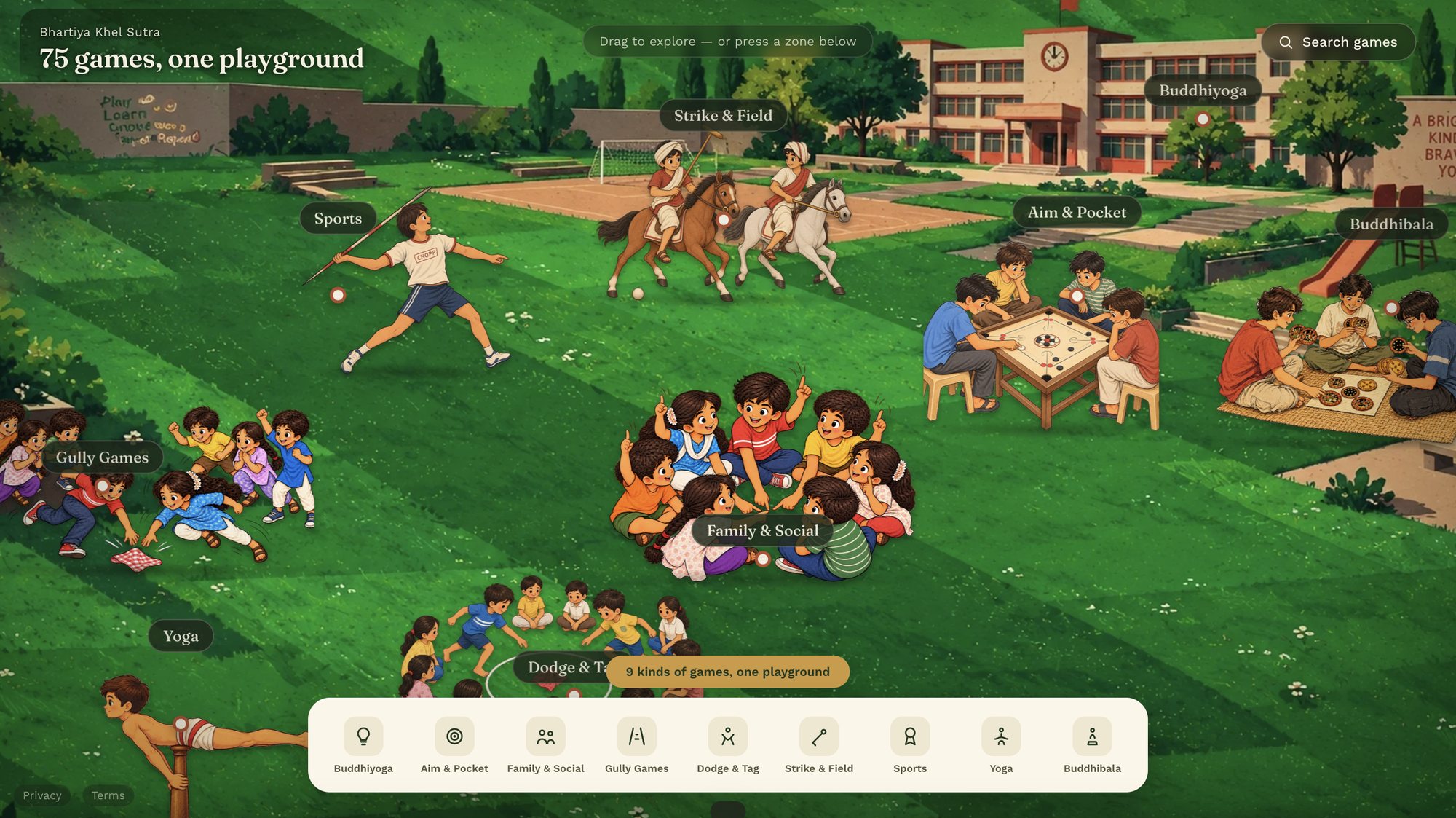
Two ways in, one structure. Drag across the playground and a pin opens a game; a zone opens as its own room. Or go straight to Find a game, for the teacher who needs a title now.
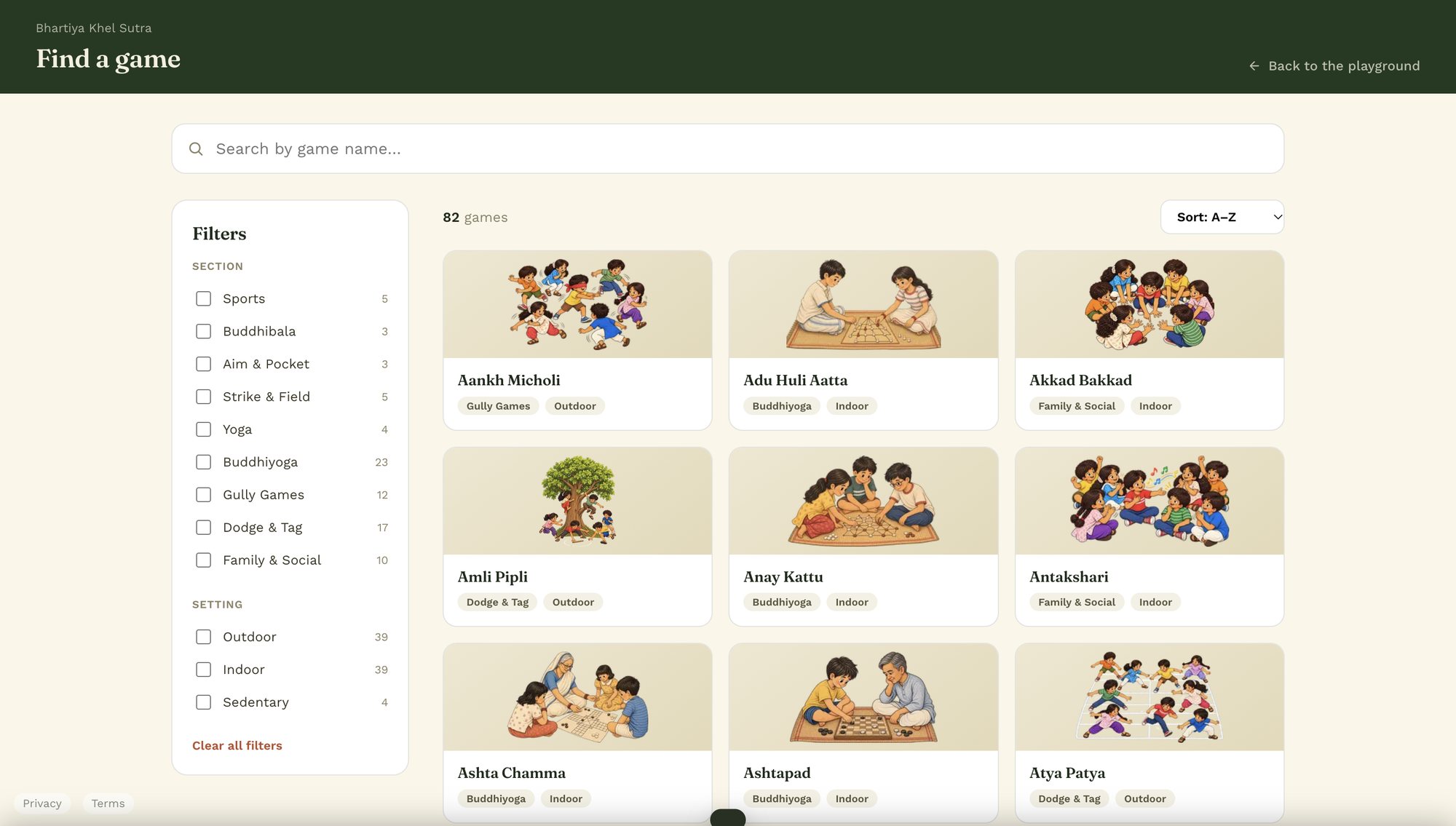
  • A result opens the game inside its own room, not a separate page.
  • Each result shows that game's own illustration, not a zone icon.
  • Only filters with real data: section and setting.
Home
Home screen: an illustrated playground with pins for nine game zones
Wander: the home screen is a playground with a pin for every zone.
Find a game
Find a game: search by name, filter by section and setting, results with a thumbnail per game
Search: by name, filtered by section and setting.

04 — The world

A world
with rooms

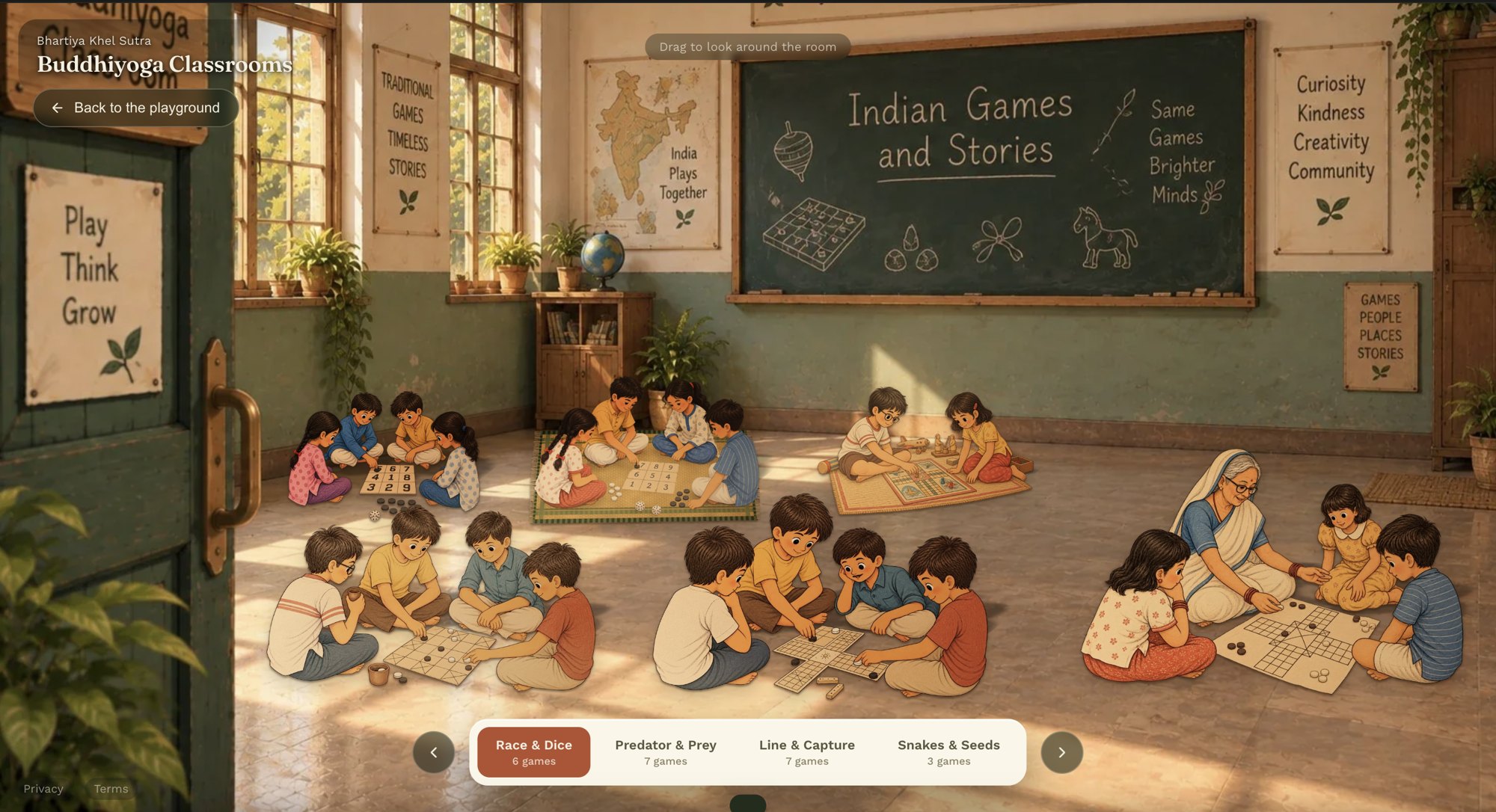
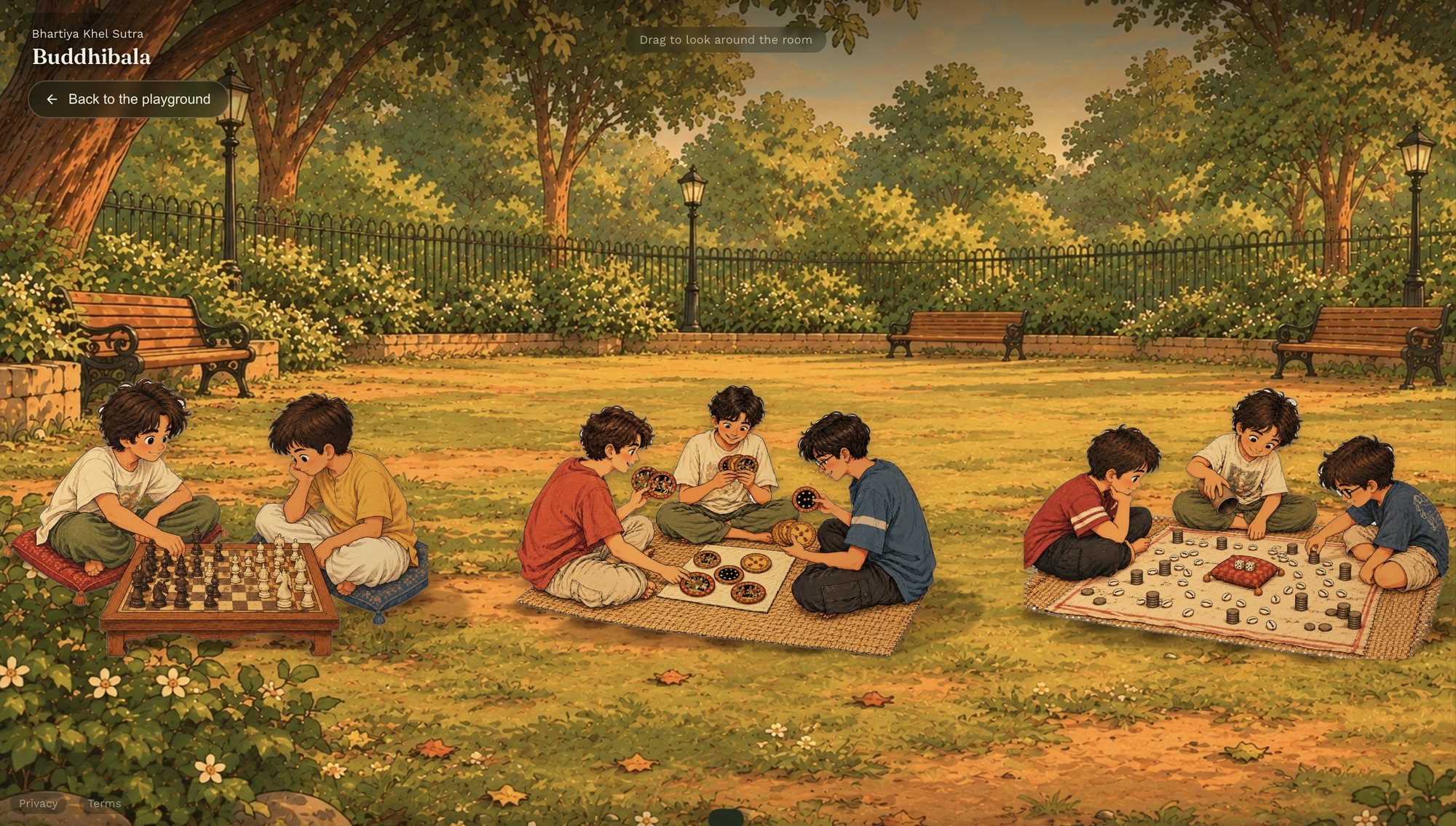
Every zone is an illustrated environment, and games stand where they would be played. One tab bar sits along the bottom, so moving between genres never reloads the scene.
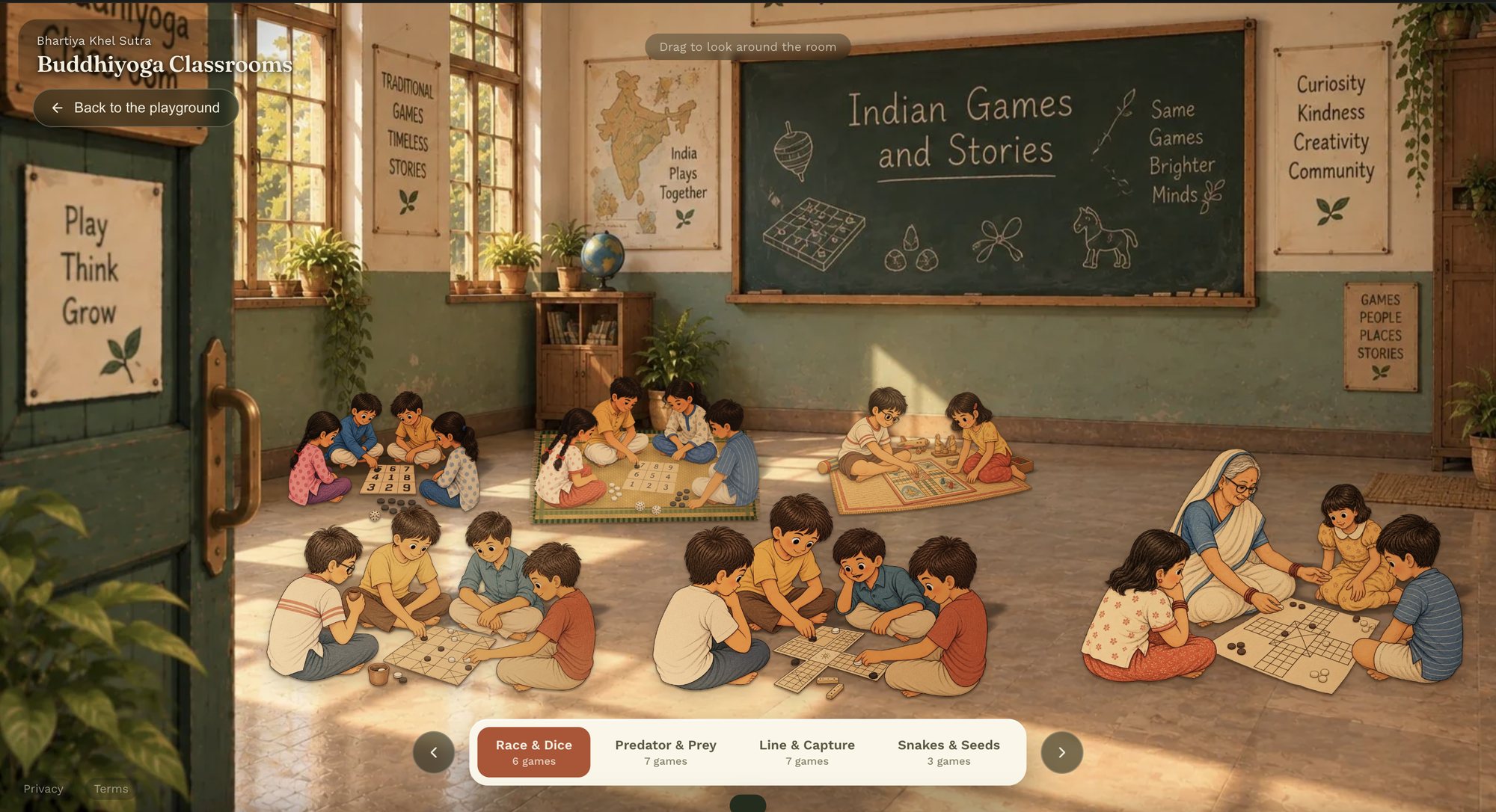
Buddhiyoga · classroom
Buddhiyoga classroom: children playing board games on mats, with a tab bar for game genres
The classroom. Changing genre is a tab, not a page.
Buddhibala · pavilion
Buddhibala pavilion: an illustrated environment with game pins
The pavilion. Same top bar, same way back.
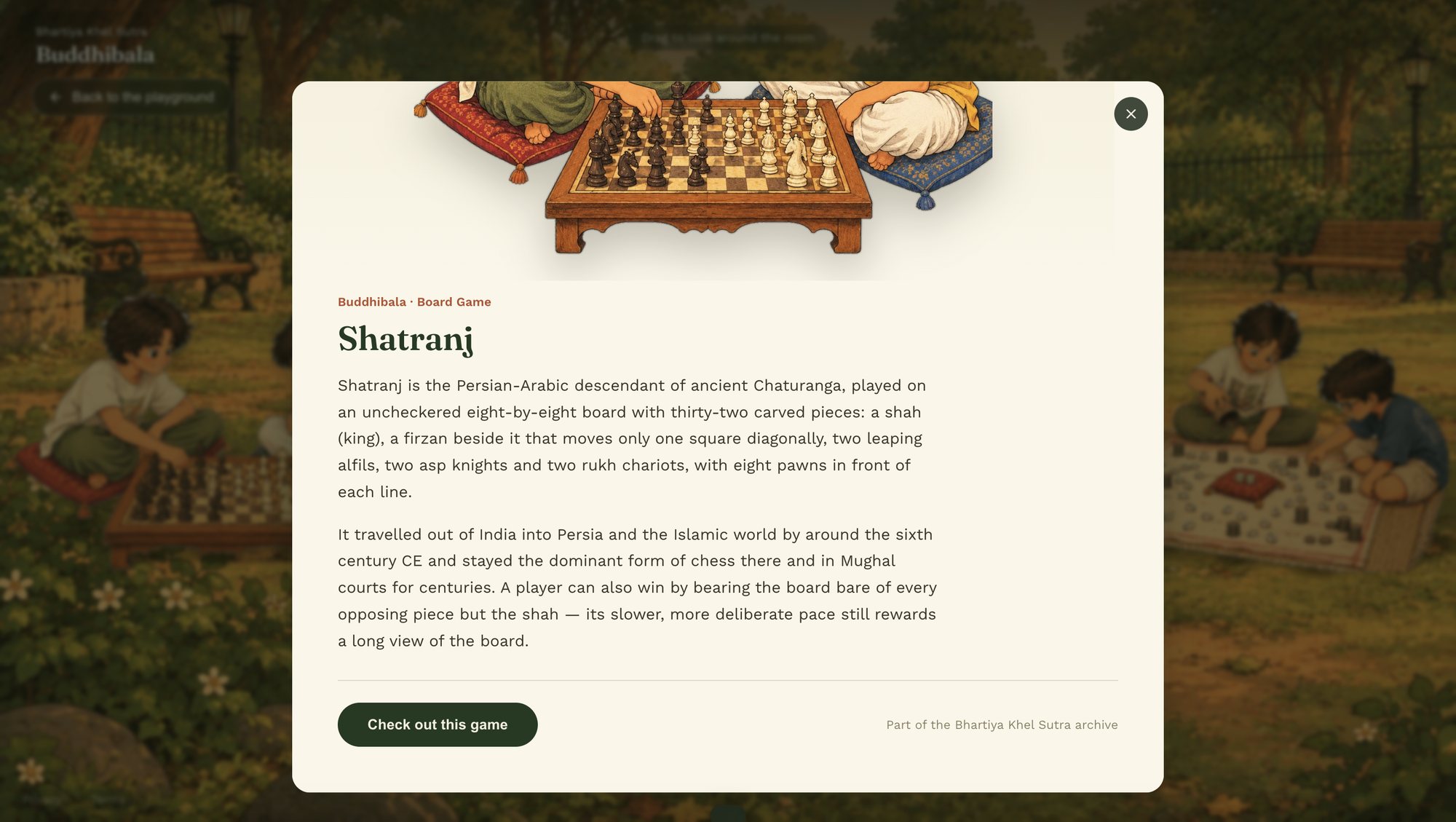
Game card
Game card for Shatranj over its environment: synopsis, equipment and a link to the full game
The game card: what it is, what you need, a way into the full rules.
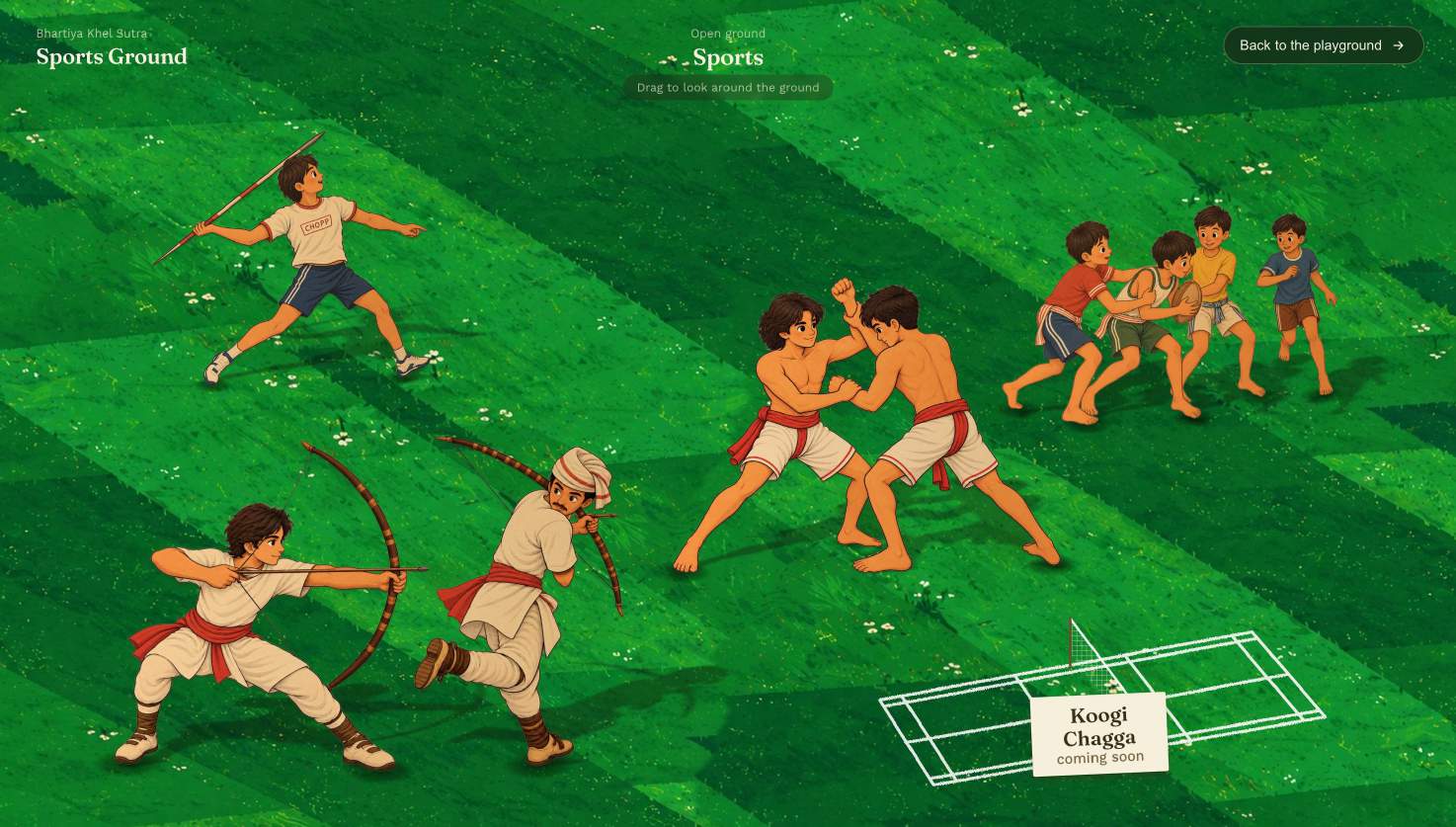
Sports ground
Sports ground: open grass with archery and wrestling figures and a back link
The sports ground. Open grass, the same bar and the same way back.
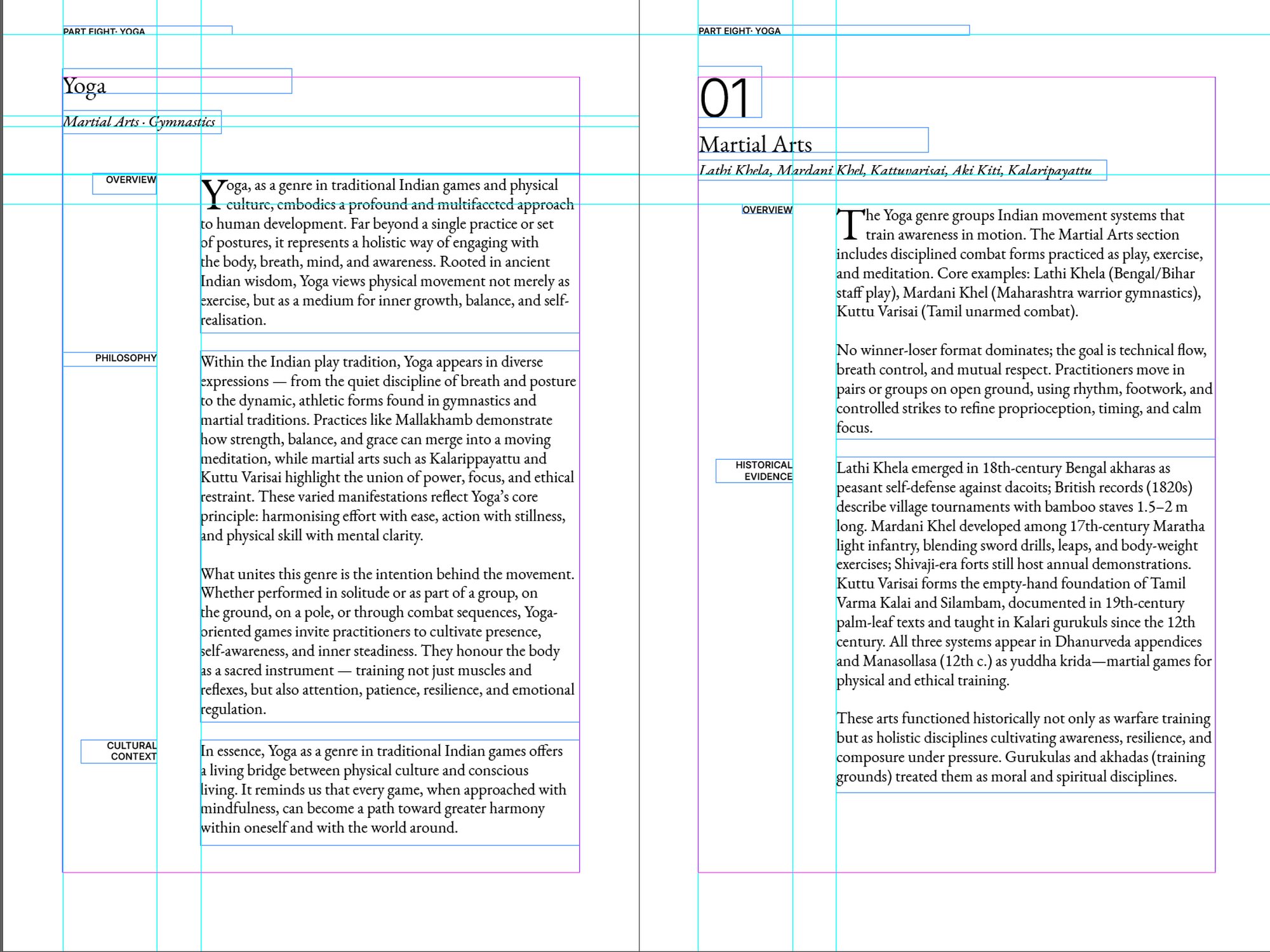
Typeset yoga spread from the rulebook
Yoga & Martial spread
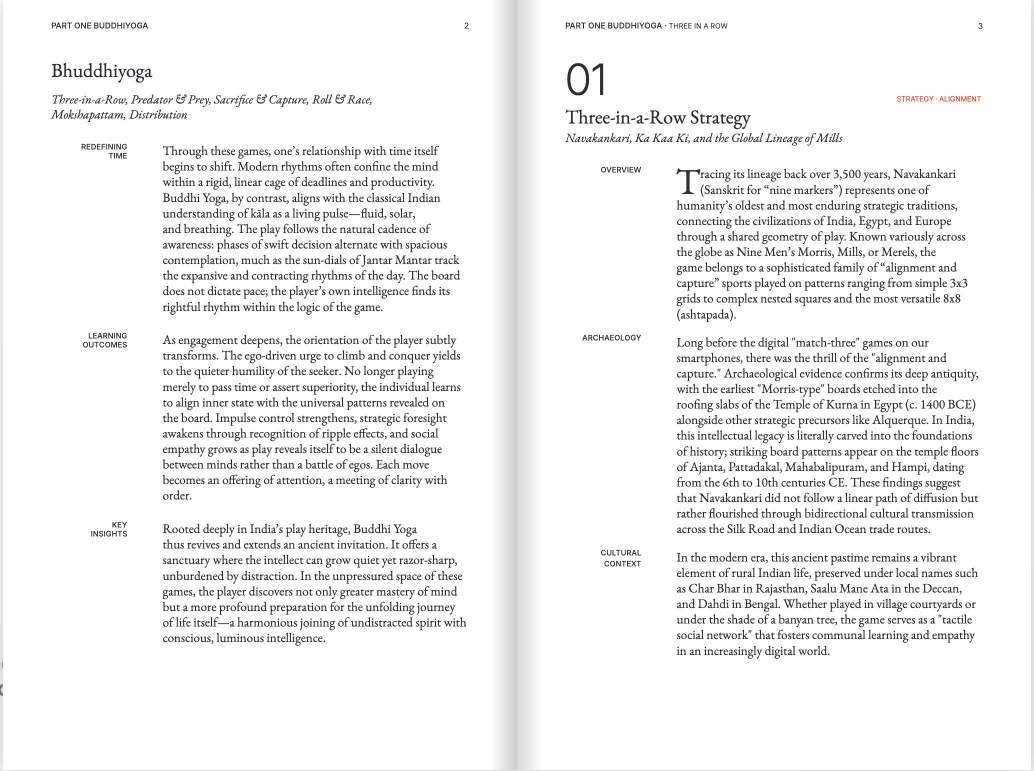
Typeset rulebook spread: Part One, Buddhiyoga, with a margin column of labels
Part One: Buddhiyoga
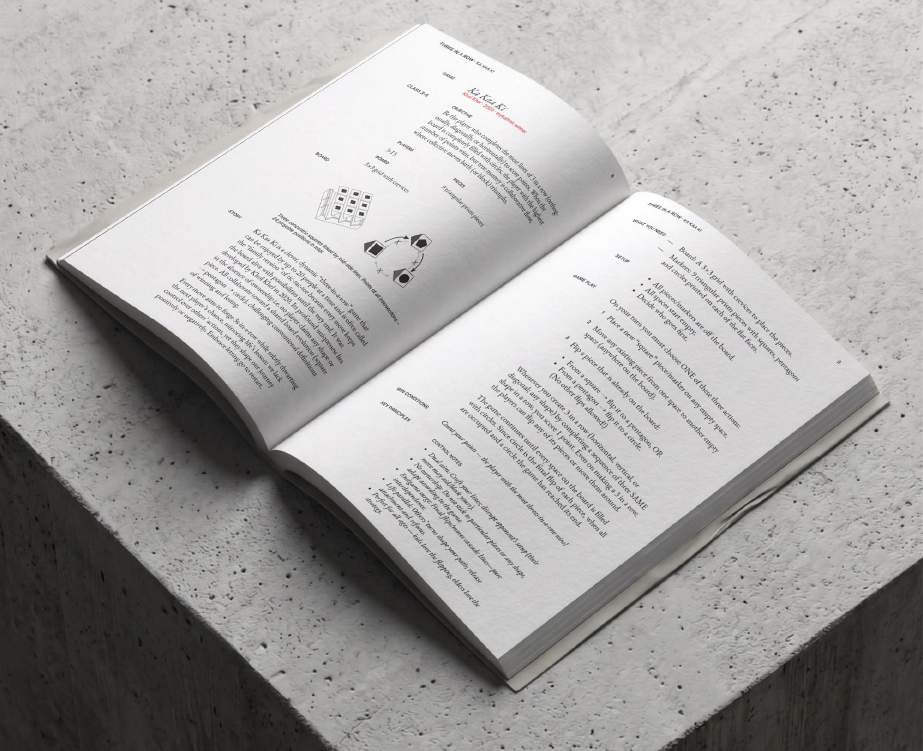
Mockup of the printed rulebook lying open on a concrete surface
The rulebook, printed

05 — Editorial

The same research,
in print

The research behind each game was also typeset as a rulebook in InDesign: part openers, a narrow margin for labels, one grid under every game page.

  • Margin labels carry the structure: overview, archaeology, cultural context.
  • The text column stays quiet. One grid, then each game dropped in.
  • Same sections as the on-screen game card.

06 — Iterations

What I changed,
and why

Feedback came in rounds. Most changes removed something instead of adding it.

Buddhiyoga · after the changes
Buddhiyoga classrooms page with game tabs, after the changes
  • 01

    Navigation

    Tried a right-edge hover drawer. Feedback: worse. Went back to the bottom dock.

  • 02

    Room headings

    Removed. The tab bar already says where you are, and it fixed unreadable text on two zones.

  • 03

    Back link

    Moved left on every zone page, matching the homepage.

  • 04

    Crowded zone

    Measured every illustration's bounds and re-plotted until nothing touched.

Contact · Work with me

Let’s make something worth using

I design products people can follow without a manual, and brands that hold together. If you have a role, a project or a problem that needs a designer, write to me.

  • Product design roles Open
  • UI / UX projects Open
  • Brand identity Open
drritipasrija11@gmail.com
© 2026 Drriti PasrijaBack to top ↑